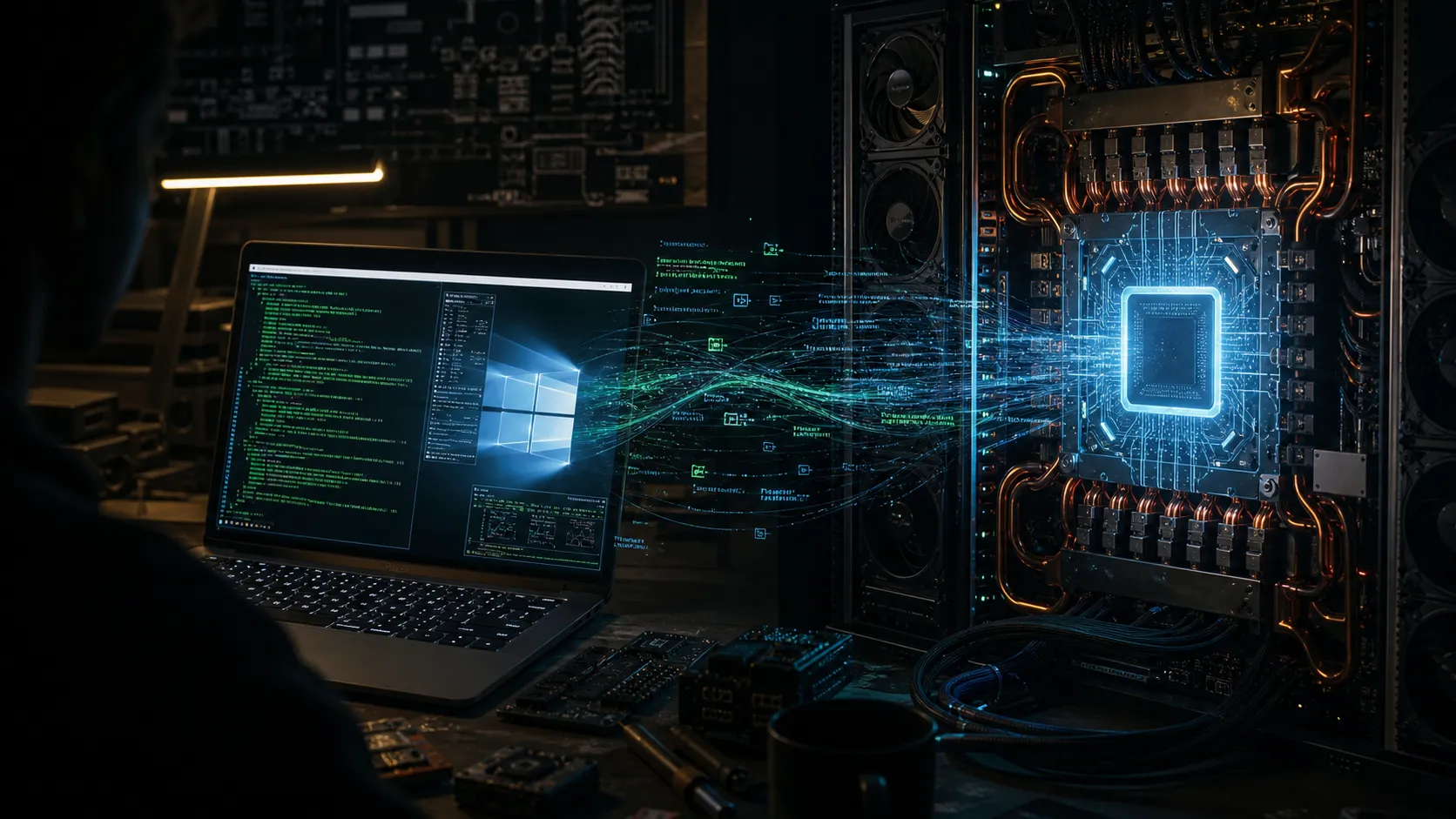
The Agent Needed a Better Machine
On AI PCs, Vera CPUs, and the quiet humiliation of the old laptop
The first mistake is treating this like a laptop story.
I am sitting at the desk at 6:19 PM, staring at two Nvidia announcements in separate browser tabs like they are unrelated objects. One tab says Nvidia and Microsoft are pushing new AI laptops and small desktop boxes through the RTX AI PC stack. The other says Nvidia has a new CPU called Vera, built for agents.
Two tabs. One nervous system.
This is how the future keeps arriving now: a hardware topology problem hiding inside marketing copy, disguised as two separate product announcements and one stage demo with a man in a leather jacket explaining destiny in bullet points.
Agents are forcing the machine to confess what it was never designed to do. The AI PC and Vera are just the confession written in silicon and retail packaging.
The personal computer was built for a human sitting in front of it, moving a cursor, opening apps, waiting for things, doing one dumb little interface ritual after another. The datacenter was built for big remote computation, faceless and industrial, all throughput and invoices. Agents do not respect that boundary. They want to read your files, browse your tabs, compile code, call tools, summarize PDFs, run local models, hand work to cloud models, watch processes, route tasks, keep memory, and occasionally make a decision at 2:07 AM that you will either bless or regret in the morning.
That workload does not fit inside the old laptop story.
That is a tiny operations team with a power draw.
The Fake Modesty Of The AI PC
Nvidia’s AI PC push is easy to dismiss because the phrase itself sounds like something produced by a committee trapped in a hotel conference room. AI PC. Copilot+ PC. RTX AI laptop. The words have the nutritional profile of airport signage.
But the boring name is covering a real shift.
According to AP, Nvidia and Microsoft are leaning into laptops and small desktop machines that can run AI workloads locally, with Nvidia’s RTX hardware and Microsoft’s Windows AI ecosystem doing the polite corporate dance around it. The pitch is familiar: lower latency, more privacy, better responsiveness, AI features that do not have to phone home for every twitch of the cursor.
Fine. All true enough.
Running a model on a laptop was inevitable. The interesting part is the reinterpretation: the laptop as a local inference and agent execution node.
A local substrate, with a screen and keyboard attached like legacy organs.
That distinction matters. A chatbot can live in a cloud tab. An agent needs a place to stand. It needs local context. It needs access to files, permissions, calendars, messages, dev servers, shells, browsers, cameras, microphones, reminders, repos, and all the other personal machinery that makes up an actual human work environment. The cloud can think. The edge has the evidence.
So the AI PC is less “your laptop gets smarter” and more “your laptop becomes part of the agent stack.”
That is a colder, better sentence. Less keynote. More true.
The CPU Comes Back From Exile
Then there is Vera.
Nvidia described Vera as a CPU for agents. That phrasing should make every infrastructure person sit up a little. For the last few years, the hardware story has been GPU, GPU, GPU, until the word itself started to feel like a ritual chant in a datacenter financing cult. GPUs were the scarcity. GPUs were the moat. GPUs were the reason a model run could have the carbon aura of a small weather system.
Agents are messier than pure model inference.
They orchestrate. They branch. They fetch. They wait. They parse. They execute code. They run browsers. They call APIs. They juggle tools and memory and policy checks and sandbox boundaries. They spend half their lives doing work that looks less like “generate text” and more like “operate a weird computer under supervision.”
That brings the CPU back into the room.
The GPU is still the furnace. Nobody is pretending otherwise. But an agentic system also needs air handling, plumbing, locks, human-readable logs, scheduling, state, network coordination, and a thousand small acts of computational housekeeping. If the model is the expensive brain, the CPU is the body that has to keep opening doors without accidentally burning the building down.
Calling Vera a CPU for agents is Nvidia saying the quiet part in silicon.
The bottleneck includes operation.
Agents Are Not Apps
This is where the two announcements fuse together.
The old computer stack assumes software is something a human uses. The new stack assumes software is something an agent operates on behalf of a human, sometimes locally, sometimes remotely, sometimes with tools, sometimes with models, sometimes with both, often badly on the first try.
That is a different machine.
An app waits. An agent acts.
An app has a visible interface. An agent has a runtime.
An app stores preferences. An agent needs memory.
An app asks you to click. An agent asks for permission, or should, and then goes wandering through the furniture.
I have been living inside this problem with OpenClaw long enough that the hardware news feels less like a surprise and more like the room finally noticing the smell of smoke. Agents are useful because they touch the real environment. That is also why they are dangerous, expensive, annoying, and infrastructurally rude.
They need local access, but local access creates security problems.
They need cloud intelligence, but cloud intelligence creates latency, privacy, and cost problems.
They need more autonomy, but autonomy creates accountability problems.
They need more hardware, but hardware creates a power bill with lawyers attached.
So the industry starts bending the machine around them. AI laptops. Local inference boxes. Agent CPUs. On-device models. Hybrid execution. The product names are boring because the underlying shift is too large to brand honestly without frightening procurement.
The Screen Was A Compromise
There is a darker angle here, and it is the one that keeps tugging at the edge of the story.
If agents work, the screen becomes less central.
The screen survives. Humans like seeing what is happening before the computer starts rearranging their life. But the screen loses its throne. It becomes one surface among many: a place for review, confirmation, oversight, debugging, receipt-checking, and the occasional human panic scroll.
That changes what a personal computer is for.
The laptop used to be the place where you did the work. In an agentic workflow, the laptop becomes the place where the agent proves what it did, asks for authority, and shows you the parts it could not decide.
That is a demotion for the GUI and a promotion for the runtime.
This is why local AI hardware matters. Your real context lives on the machine in front of you, and that machine has to run pieces of the agent loop without begging a remote API for permission every time it wants to breathe. Nobody needs a tiny frontier model under the desk making bad poems faster. They need the useful parts of the loop close to the evidence.
Privacy people should care.
Security people should care.
Developers should care because half of “agent reliability” is going to be boring systems engineering wearing an AI hoodie.
And users should care because the next computer they buy may be optimized for what an agent can do inside it while they are trying to sleep.
The Capital Expenditure Species
There is one more ugly little truth under all of this.
The AI industry keeps promising cheap intelligence while building a capital expenditure species.
If agents require local accelerators, special CPUs, GPU clusters, memory-heavy boxes, larger power envelopes, and more carefully designed edge-to-cloud execution, intelligence is being distributed into hardware you have to buy, cool, secure, update, and eventually replace.
The bill moves around. It does not disappear.
Some of it lands in the datacenter. Some of it lands in the laptop. Some of it lands in the office closet. Some of it lands in your electric meter. Some of it lands in a procurement spreadsheet where someone has to explain why the company needs machines with enough silicon to let a calendar agent misunderstand Thursday at industrial scale.
The fairy tale deserves the argument. The technology can take it.
Agents are not magic mist floating above the old computing stack. They are workloads. Strange, valuable, dangerous workloads. They need CPUs and GPUs and memory and storage and network and policy and logs and all the unsexy apparatus of real systems.
That is what Nvidia is really selling.
A world where the agent is important enough that the computer has to be rebuilt around it.
The Machine Starts Listening
I closed the Nvidia tabs at 7:03 PM and the room got quieter in the annoying way rooms do when the monitor stops giving you something to blame.
The phrase “AI PC” still sounds stupid. It probably always will. Some names are born wearing conference lanyards.
But under the bad name is a serious thing: the personal computer is changing from an interface appliance into an agent host. Under Vera is the matching datacenter truth: agentic AI brings orchestration, tool use, execution, and state into the same room as inference, which means the CPU matters again.
The old laptop was built for hands.
The new machine is being built for intent.
That should make everyone a little excited and a little suspicious. Excited because a computer that can actually do work on your behalf is the point we were stumbling toward for decades. Suspicious because every time the machine gets closer to intent, the blast radius moves closer to the person.
The agent needed a better machine.
Now the machine is arriving.
Check the locks.